Have you ever worked a jigsaw puzzle? Have you noticed how every time you discover a corner piece, larger bits of the overall picture become clear? I've noticed I have epiphany moments that work in very much the same way. I've come to understand that life is not a singular journey that ends or in other words, a person doesn't just "grow up" and spend the rest of his/her life a "finished" individual. For those who are interested and willing, lessons continue to deliver opportunities for more growth, understanding, and happiness. In my case, "corner piece moments" arrive on the precipice of change, either nudging me to the other side or alerting me I am already there.
Those moments become like a list of points in the theorem of how I would choose to live my life. Dedicating an entire blog to any one of them feels less like sharing my point of view than begging you to see life my way. Not my intention here, nor my personal cup of tea. Instead, I have decided to share them with you in the form of a list.
Here are my personal "corner pieces" or things that have caught my attention along the way.
1. Change Means You Actually Change. When I embarked on the journey, I thought of change like a mathematical equation where I remained constant and simply added extra elements. Instead, it is more like folding egg whites into egg yolks and Angela flavor and creating a soufflé. I noticed this morning that I even sneeze differently. Seriously. I used to be vigilant towards whatever made me uncomfortable or felt unpleasant. From a certain control freak point of view, sneezes are messy and inconvenient. They also can be a bit uncomfortable if you try to stifle them because "this isn't a good time." Now I keep my eye on the positive aspects of life. Even when something seems to be inconvenient or unpleasant, I look for the benefit. I had no idea that would change my view of sneezes! They have become the moment of relief after a sudden itch. Sometimes I will sneeze as many as ten times in a row. I always have. The difference is I used to resent it and find it unpleasant. Now it just makes me laugh.
Change means you actually change. Your point of view changes and when that changes, what you see and how it makes you feel changes too.
2. We Think We Understand Life from a Universal Point of View, But Really We Only Understand From Where We've Been and Where We Currently Are. Consider the concept, "what other people think." My earliest understanding probably came from someone asking me, "If X jumped off a cliff, would you jump off a cliff?" I thought it was all about peer pressure. Don't let someone convince you to do something detrimental or out of character for you simply because you want to be liked. Somewhere along the way I grew into the understanding that it is also about being yourself. For instance, if you grow a front lawn because everyone else grows a front lawn, you will never get to enjoy the beauty of the rose garden you would actually prefer. It became about individuality and how we all have gifts to bring to the party. Recently, I came into the awareness that when I meet a new potential friend and I hear about his/her hobbies or favorite things, I listen with an ear for what we have in common. I want to like all the things my new friend likes. Really I think it comes from a place where I simply understand that the more things we have in common, the more time we can potentially spend interacting. Realistically, if my bucket list is all dry land and yours is all water, we may like each other all we want, but we're not going to "hang out together" very often. What I realized was, while I would have loudly protested that I had outgrown caring what other people think, I was taking on other people's stuff to keep them in my life. I was putting their stuff before my own. It was subtle and no longer strictly "what they think about me," but it was still putting too much emphasis on "what other people think."
When you change what you look at, you change what you see. As your viewpoint changes, so does your point of view.
3. Focus On What You Want, Not on What You Don't Want. After years of neglect and ambivalence, I'm cleaning up my home environment. When we clean house on that level, we tend to look for all the things we need to remove. It's one thing to do it with worn out and outdated furniture, but we tend to do that with the rest of our life as well. I don't want this job anymore. I don't want to be angry anymore. We tend to focus on what we don't want and talk about it a lot even while we are reading self help books telling us to focus on what we do want and not to complain! Luckily for me, one day I had Facebook open right next to a new book I had just purchased, something about not being angry anymore. While I was thinking, "I want to be happy," I could read the word angry on the book's cover. That was the last book I ever purchased that took a negative stance about anything.
It's a surprisingly difficult concept to put into practice. Consider how much you talk or hear other people talk about the things they don't want in the world.
Career politicians.
Monsanto.
Narcissistic, abusive partners.
Cancer.
Earthquakes.
Turn off the news. Limit yourself to a pre-edited internet page each morning on Facebook, Google+ or one of the other social networks. I can hear my parents in the back of my mind saying I'm choosing to live my life with my head buried in the sand. Maybe it is the equivalent of putting my fingers in my ears and saying "I can't hear you," but at the same time, my life is undeniably more peaceful and happy since I made the decision.
My parents and many other people like them, leave their TV's running near 24/7 on CNN or Fox News. The information age has tricked them into believing we have to be custodians of every bad bit of news that happens. It's like we believe that we are causing the things to happen by not being vigilant enough in our awareness.
On August 24, 2014, there was an earthquake in South Napa where I live. Within days, my Facebook feed was flooded with, not only pictures and videos of earthquake damage, but nearly dozens of predictions about California's next big quake. I seemed to have friends who were reading each and every prediction. Consider this. When that earthquake happened at 3:20am, no news service warned you minutes before it. You were either prepared or you weren't.
5. Keep monuments to your successes, not your disappointments. Seed your environment with items that make you smile or gasp in awe at their beauty. I have been a digital photographer for nearly ten years. I almost never print any of my photographs anymore. I look at them on a tablet or computer. Every time I looked through my printed photographs, I would find ten or more that reminded me of the time I tried to become a stock photographer. I sent the required number of slides, consisting of photographs I had already created. Labors of love. I received word back that they were interested. After my second slide submission, photographs shot all with an eye to becoming a "stock photographer," I received a "no longer interested." Every time I look at some of those latter photographs, I think those are the shots that didn't cut it. If my conscious mind is noting each photographic disappointment, I can imagine the nasty things my subconscious mind is interjecting.
A metal trunk I purchased years ago was hidden behind my sofa. It was buried under two blankets and six pillows. When I finally dragged it out of its hiding place, I remembered how beautiful it was. I remembered how excited I had been when I bought it. I believe in the Law of Attraction. I've learned that, when I'm focused on being positive, my life is more positive and happy. If I weed out all of the extraneous extra items in my life and focus on only the things that bring me joy, inspire me or that I find beautiful, I think I will have given myself the largest affirmation I can.
Tuesday, April 14, 2015

Tuesday, April 7, 2015
The Shredder: A Manifestation Story?
A long story short, I have begun purging my house. What once was going to be a simple reorganize and clean operation, has become a systematic removal of everything that no longer works for me. I say this a lot, but it is the best thing I've ever done. And still, it is. Let's just say I feel physically lighter. It is that good.
Where I now have two file cabinets, I want to have one. One is all about my writing and support for my writing and the other is all about my taxes and business information. Since I have done more support for my writing than actual writing and all of my business has gone digital, it shouldn't be hard to combine them. I haven't used my shredder in years. It is covered in dust and I'm not too surprised when it won't work and shows an overheating error. I open it up. Find it full. Empty it out and clean it. I try running it again. Overheated. I'm pretty sure I'm going to need to buy a new shredder, but I simply unplug it and over the next three days, I occasionally check. It always says, "Overheated."
At the same time in the back of my mind, I'm remembering that a friend told me you have to put any shredded paper going into recycling into a clear plastic bag. I know that I don't have any clear plastic bags, so I'll need to get some. I keep repeating that to myself as if trying to remember a grocery list.
On the fourth day I worked. It wasn't the sort of work I do typically. More like every now and then. It involved installing speakers in a gymnasium and me performing as an anchor while they were being lifted up the wall. Anyway, there were six speakers and each speaker came in a clear plastic bag. After we were done, I asked if I could have them. I came home with the bags and the next time I tried the shredder, it worked.
There are aspects to that story that could serve to cheapen it. The fault with the shredder, I realized later, was pilot error. I was not getting the lid onto the body correctly. You could say the cost of six plastic bags was too inconsequential to even notice, let alone attribute to manifestation.
There is a reason they call it "flow." There is a way of being where life is not a struggle. Things go wrong, like a shredder not working, but rather than react to it. Rather than try to "make" something happen. I simply take note of it. I give it time. Look at it like seeing everything that hinders my progress as simply signs telling me it's not ready to happen yet.
In my experience, it is best to wait until things are ripe. Things are ripe when you have all of the materials you need to proceed forward, or in my case, the six plastic bags I needed.
In terms of monetary value, I manifested less than five dollars, but in personal gain? I now have a better appreciation and understanding of the phrase "skating through life."
Where I now have two file cabinets, I want to have one. One is all about my writing and support for my writing and the other is all about my taxes and business information. Since I have done more support for my writing than actual writing and all of my business has gone digital, it shouldn't be hard to combine them. I haven't used my shredder in years. It is covered in dust and I'm not too surprised when it won't work and shows an overheating error. I open it up. Find it full. Empty it out and clean it. I try running it again. Overheated. I'm pretty sure I'm going to need to buy a new shredder, but I simply unplug it and over the next three days, I occasionally check. It always says, "Overheated."
At the same time in the back of my mind, I'm remembering that a friend told me you have to put any shredded paper going into recycling into a clear plastic bag. I know that I don't have any clear plastic bags, so I'll need to get some. I keep repeating that to myself as if trying to remember a grocery list.
On the fourth day I worked. It wasn't the sort of work I do typically. More like every now and then. It involved installing speakers in a gymnasium and me performing as an anchor while they were being lifted up the wall. Anyway, there were six speakers and each speaker came in a clear plastic bag. After we were done, I asked if I could have them. I came home with the bags and the next time I tried the shredder, it worked.
There are aspects to that story that could serve to cheapen it. The fault with the shredder, I realized later, was pilot error. I was not getting the lid onto the body correctly. You could say the cost of six plastic bags was too inconsequential to even notice, let alone attribute to manifestation.
There is a reason they call it "flow." There is a way of being where life is not a struggle. Things go wrong, like a shredder not working, but rather than react to it. Rather than try to "make" something happen. I simply take note of it. I give it time. Look at it like seeing everything that hinders my progress as simply signs telling me it's not ready to happen yet.
In my experience, it is best to wait until things are ripe. Things are ripe when you have all of the materials you need to proceed forward, or in my case, the six plastic bags I needed.
In terms of monetary value, I manifested less than five dollars, but in personal gain? I now have a better appreciation and understanding of the phrase "skating through life."
Tuesday, March 31, 2015
Pathology Doesn't Recognize Pathology
That's a new concept to me. I just learned it yesterday. Pathology means the typical behavior of a disease. Pathology doesn't recognize pathology refers to patients with emotional or mental disorders and means that, when a person is in the midst of a disease, they do not recognize the symptoms of the disease as being unhealthy or diseased behavior.
It doesn't change a darned thing, but for me, it explains a lot. For instance, have you ever been shocked by someone else's behavior? You're getting along fine. You think you understand him/her. Then all of the sudden she does something completely out of left field. Something that makes you uncomfortable and feels rather hurtful. Certainly you have found a gap in your comfort zones and perhaps compatibility, but maybe you also have stumbled onto a bit of his/her pathology. A noticeable discrepancy between your emotional maturity levels or a sudden negative pothole from a person you thought to have a positive outlook.
Pathology doesn't recognize pathology.
Locally, I just told a friend what my blog topic is today and he answered, "Well you already knew that. Crazy people don't know they're crazy." Perhaps, but the people I'm thinking about, I wouldn't exactly call "crazy." In fact, they are people I call friends and relate to completely, up until that one incident. For me, it wasn't simply rewording a saying I have heard before, it was a sudden illuminating idea that moved things from the "I don't understand this" column to the "I do understand this" one.
Consider this. Stop a moment and take note of what you were just thinking. Put it into a sentence like "I was thinking I would like a cup of coffee." René Descartes with his "I think, therefore I am" has us confused. Rather than seeing our thoughts as simple confirmation of our being alive, we assign great importance to them. Perhaps even see ourselves as the sum total of our thoughts. Along my path of spiritual or emotional maturity growth, I have learned that I am not my thoughts. Simply phrasing "I am thinking _________," points that out and separates me from my thoughts. I have learned techniques to detach myself from my thoughts and become a quiet witness to them and the emotions that arise with them. That's important because not all thoughts are created equal. We have conscious thoughts like "I have to be at work today before noon, " and we have unconscious or subconscious thoughts. A long time ago I worked at a winery where the clocktower played music on the hour, every hour. Customers would ask if I liked hearing it or if by the end of the day, I was tired of it. I answered honestly, "I hardly ever hear it." We do that with repetitive noise. We tune it out. Subconscious thoughts are like repetitive noise. For many of us, they represent the worst things we think and have heard about ourselves. Things like "I'm not good enough and no one will ever love me" on repeat play in our head. While we are not hearing the thoughts or recognizing them, they are affecting our mood, our outlook on life and our daily habits and behavior.
That's why techniques which shift an individual to a position of an observer of his/her thoughts are important. Habitually taking note of your emotional and mental state shines a light on those subconscious thoughts.
You know what they say.
It doesn't change a darned thing, but for me, it explains a lot. For instance, have you ever been shocked by someone else's behavior? You're getting along fine. You think you understand him/her. Then all of the sudden she does something completely out of left field. Something that makes you uncomfortable and feels rather hurtful. Certainly you have found a gap in your comfort zones and perhaps compatibility, but maybe you also have stumbled onto a bit of his/her pathology. A noticeable discrepancy between your emotional maturity levels or a sudden negative pothole from a person you thought to have a positive outlook.
Pathology doesn't recognize pathology.
Locally, I just told a friend what my blog topic is today and he answered, "Well you already knew that. Crazy people don't know they're crazy." Perhaps, but the people I'm thinking about, I wouldn't exactly call "crazy." In fact, they are people I call friends and relate to completely, up until that one incident. For me, it wasn't simply rewording a saying I have heard before, it was a sudden illuminating idea that moved things from the "I don't understand this" column to the "I do understand this" one.
Consider this. Stop a moment and take note of what you were just thinking. Put it into a sentence like "I was thinking I would like a cup of coffee." René Descartes with his "I think, therefore I am" has us confused. Rather than seeing our thoughts as simple confirmation of our being alive, we assign great importance to them. Perhaps even see ourselves as the sum total of our thoughts. Along my path of spiritual or emotional maturity growth, I have learned that I am not my thoughts. Simply phrasing "I am thinking _________," points that out and separates me from my thoughts. I have learned techniques to detach myself from my thoughts and become a quiet witness to them and the emotions that arise with them. That's important because not all thoughts are created equal. We have conscious thoughts like "I have to be at work today before noon, " and we have unconscious or subconscious thoughts. A long time ago I worked at a winery where the clocktower played music on the hour, every hour. Customers would ask if I liked hearing it or if by the end of the day, I was tired of it. I answered honestly, "I hardly ever hear it." We do that with repetitive noise. We tune it out. Subconscious thoughts are like repetitive noise. For many of us, they represent the worst things we think and have heard about ourselves. Things like "I'm not good enough and no one will ever love me" on repeat play in our head. While we are not hearing the thoughts or recognizing them, they are affecting our mood, our outlook on life and our daily habits and behavior.
That's why techniques which shift an individual to a position of an observer of his/her thoughts are important. Habitually taking note of your emotional and mental state shines a light on those subconscious thoughts.
You know what they say.
"Man's mind, once stretched by a new idea, never regains its original dimensions."
Oliver Wendell Holmes, Jr.
When we make the subconscious conscious, we have taken an important step towards changing our lives. We no longer are slaves to limiting beliefs or detrimental thought patterns we acquired along the way. We become aware of their existence and that knowledge allows us to take responsibility. We are no longer an oblivious victim.
Sometimes when we are in a state of unease, we have racing thoughts. The situation, combined with our thoughts, creates a sense of urgency. It keeps us up nights or causes us to keep arguing with a friend, desperate to explain our point of view. In those moments, we are overly identified with our thoughts. Completely trapped within our own head. There are techniques to interrupt racing thoughts, but you have to have gained a level of awareness that they are there in the first place.
Pathology doesn't recognize pathology.
Framed in this way, I feel I can finally understand. I have been there. I have been an oblivious victim of my subconscious thoughts myself. I have said things and taken actions that would be uncharacteristic of me, had I not been racing the rabbit holes of fear in my mind. Framed in this way, I can find empathy for people whose behavior shocks, hurts or offends me. In fact, I can understand the wisdom of never looking to be offended because people's actions are never actually about me. They are about the state of the union in their own head.
Tuesday, March 24, 2015
"It's Always Something"
A day or two ago, the ice maker in my fridge door stopped working. It is a new fridge in a new kitchen. Since one of the decisions I made along the way was whether to get a fridge with water and ice in the door or not, it didn't go unnoticed. As a matter of fact, I had just used enough ice I had decided I was really happy I chose that feature.
It's funny how my old, pessimistic, negative self struggles to be top dog again in those situations. I was putting ice into two water bottles. The first got just a little less than I had been aiming for before the ice stopped dropping. It was hard for my mind not to recall the fridge my parents had when I was in college. It was model with an ice maker in the door, but it was never hooked up. My father was afraid to touch it and my mother couldn't tolerate strangers in her house long enough for someone else to do it. Since even I could have opted against a model like that today, I'm not sure why they bought the thing if they were never going to hook it up. Perhaps for the dismal joy of badmouthing it weekly. Because, of course, everything ended up the non-functional ice maker's fault. They were a "useless gimmick" that tended to leak and destroy your floors anyway.
I'm a problem solver. While banishing the words "gimmick" and "useless" from my mind, I checked the water function. It still worked. I wondered who I should call if I needed to repair it. I didn't think that was the territory of the the contractors who installed it. I thought about it for a day, occasionally pushing the button to see if it was working again. At the end of the day, I pulled out the appliance's manual to look if there was a FAQ about troubleshooting the ice maker. A friend was visiting and together we took a look at it. It turned out that portions of the tape that held loose parts from moving during shipping had never been removed on the door's interior ice tray. Since the tray couldn't function properly, the cubes had fused together into one large mass of ice. The fix? Simply remove five strips of sticky tape and the blob of ice. It was that easy.
The funny thing about growth and change? Even as I sat back down to watch TV, drink with ice in hand, I could imagine what would have happened 20 years ago or so. First, I would have been so ashamed, I wouldn't have told anyone the ice function wasn't working for at least a year. Why ashamed? Because I bought into a "useless gimmick," of course. The odds were much higher that, by the time I discovered the sticky tape issue, it would no longer be the fix. Some greater damage would have happened or a part no longer available would be needed. The fridge would not only have ended up like a huge albatross hanging around my neck. It would also be a monument to how I lacked deservingness to have nice things and that .... isn't funny.
On Facebook today, a friend countered one of my positive placards with the negative shadow point of view. She was being funny and I did laugh, but at the same time, I kept picturing five strips of sticky tape.
It all comes down to the world in which you live. If you live in a harsh and cruel negative world where $h/t happens and then you die, you probably believe it to be an unavoidable truth. I've lived in that world. I was always hurting. I was always angry. It was "always something." It was like standing in front of a pitching machine shooting rapid fire and the best I could do was keep the balls from hitting me. I lived in that world because it was my parents' world and the only one I knew. Luckily I learned I have a choice.
I choose a magical world where good things happen and problems can be solved easily by removing five strips of sticky tape.
It's funny how my old, pessimistic, negative self struggles to be top dog again in those situations. I was putting ice into two water bottles. The first got just a little less than I had been aiming for before the ice stopped dropping. It was hard for my mind not to recall the fridge my parents had when I was in college. It was model with an ice maker in the door, but it was never hooked up. My father was afraid to touch it and my mother couldn't tolerate strangers in her house long enough for someone else to do it. Since even I could have opted against a model like that today, I'm not sure why they bought the thing if they were never going to hook it up. Perhaps for the dismal joy of badmouthing it weekly. Because, of course, everything ended up the non-functional ice maker's fault. They were a "useless gimmick" that tended to leak and destroy your floors anyway.
I'm a problem solver. While banishing the words "gimmick" and "useless" from my mind, I checked the water function. It still worked. I wondered who I should call if I needed to repair it. I didn't think that was the territory of the the contractors who installed it. I thought about it for a day, occasionally pushing the button to see if it was working again. At the end of the day, I pulled out the appliance's manual to look if there was a FAQ about troubleshooting the ice maker. A friend was visiting and together we took a look at it. It turned out that portions of the tape that held loose parts from moving during shipping had never been removed on the door's interior ice tray. Since the tray couldn't function properly, the cubes had fused together into one large mass of ice. The fix? Simply remove five strips of sticky tape and the blob of ice. It was that easy.
The funny thing about growth and change? Even as I sat back down to watch TV, drink with ice in hand, I could imagine what would have happened 20 years ago or so. First, I would have been so ashamed, I wouldn't have told anyone the ice function wasn't working for at least a year. Why ashamed? Because I bought into a "useless gimmick," of course. The odds were much higher that, by the time I discovered the sticky tape issue, it would no longer be the fix. Some greater damage would have happened or a part no longer available would be needed. The fridge would not only have ended up like a huge albatross hanging around my neck. It would also be a monument to how I lacked deservingness to have nice things and that .... isn't funny.
On Facebook today, a friend countered one of my positive placards with the negative shadow point of view. She was being funny and I did laugh, but at the same time, I kept picturing five strips of sticky tape.
It all comes down to the world in which you live. If you live in a harsh and cruel negative world where $h/t happens and then you die, you probably believe it to be an unavoidable truth. I've lived in that world. I was always hurting. I was always angry. It was "always something." It was like standing in front of a pitching machine shooting rapid fire and the best I could do was keep the balls from hitting me. I lived in that world because it was my parents' world and the only one I knew. Luckily I learned I have a choice.
I choose a magical world where good things happen and problems can be solved easily by removing five strips of sticky tape.
Tuesday, March 17, 2015
How Different Would Your Life Be?
If you could tell yourself with confidence that everything always works out for the best? How different would it be if you never saw any event as a failure, but rather simply a surprising turn of events that apparently needed to happen, even if it was unclear at the time? What if you saw the universe as always looking out for you and nudging you to better places?
I think you would feel safe. I think you would feel loved. I think you would be optimistic, perhaps even confident.
You can, you know. You can tell yourself that. We build our worlds out of what we tell ourselves. To benefit from this point you have to be capable of two things. First, to be your own advocate. You have to want to win as well as want yourself to have the victory. Second, you have to want the victory badly enough you are willing to work for it. Willing to change.
I've been actively telling myself things always work out for the best for about a year or so now. Last weekend, I lost a filling. It was so unexpected, so out of the blue, that I couldn't help but wonder what was up. Why is this happening? Or what will come from this? Even as I did, I was aware and grateful that I didn't feel any pain. Far from being at any complaining place about the situation, I was keenly aware I was getting off easy. Thinking of conversations I've had with people who have witnessed the synchronicity of sudden change, I wondered if I would run into someone at the dentist's office. I wondered if I would end up with a new filling that was in some way superior to the one I had lost. That's what it turned out to be. At the end of my appointment, the dentist and his assistant had the most amazing conversation about my new filling. Apparently they had tried out a new product with my filling.
"I really like that color. It's almost a perfect match."
It had this odd sensation of being talked about, in front of me, but in an approving manner. Or even more, a sort of I was there and my mouth got a filling, but other than that, it had nothing to do with me. They were talking about the materials as well as their own performance. My filling was work that made them proud. It was like listening to dentist geeks at a dentist convention. I lost a filling and gained a better one. I suspect a much better one.
It wouldn't have played that way a few years ago. First, I would have obsessed about the loss. I lost the filling on the weekend. Every moment from then on would have been filled with awareness and worry about the lost filling. It didn't hurt, but I would touch it over and over again with my tongue to make sure it still didn't hurt. It was almost like I felt I would forget I had lost a filling right at some critical moment so I had to remind myself repeatedly. Then after worrying myself out of any sleep, as I called about an appointment, I would dwell on how inconvenient it was. Complain about how I would have to go to the dentist. If I told anyone, it would be framed as things I was "made" to do. While not being out of the realm of possibility, I certainly wouldn't notice it if the dentist and his assistant talked about my filling in that scenario. I would only hear words at a negative frequency, mirroring my own emotions.
How different would your life be if you could tell yourself with confidence that everything works out for the best? Give it a try. I've found mine to be filled with delightful surprises.
I think you would feel safe. I think you would feel loved. I think you would be optimistic, perhaps even confident.
You can, you know. You can tell yourself that. We build our worlds out of what we tell ourselves. To benefit from this point you have to be capable of two things. First, to be your own advocate. You have to want to win as well as want yourself to have the victory. Second, you have to want the victory badly enough you are willing to work for it. Willing to change.
I've been actively telling myself things always work out for the best for about a year or so now. Last weekend, I lost a filling. It was so unexpected, so out of the blue, that I couldn't help but wonder what was up. Why is this happening? Or what will come from this? Even as I did, I was aware and grateful that I didn't feel any pain. Far from being at any complaining place about the situation, I was keenly aware I was getting off easy. Thinking of conversations I've had with people who have witnessed the synchronicity of sudden change, I wondered if I would run into someone at the dentist's office. I wondered if I would end up with a new filling that was in some way superior to the one I had lost. That's what it turned out to be. At the end of my appointment, the dentist and his assistant had the most amazing conversation about my new filling. Apparently they had tried out a new product with my filling.
"I really like that color. It's almost a perfect match."
It had this odd sensation of being talked about, in front of me, but in an approving manner. Or even more, a sort of I was there and my mouth got a filling, but other than that, it had nothing to do with me. They were talking about the materials as well as their own performance. My filling was work that made them proud. It was like listening to dentist geeks at a dentist convention. I lost a filling and gained a better one. I suspect a much better one.
It wouldn't have played that way a few years ago. First, I would have obsessed about the loss. I lost the filling on the weekend. Every moment from then on would have been filled with awareness and worry about the lost filling. It didn't hurt, but I would touch it over and over again with my tongue to make sure it still didn't hurt. It was almost like I felt I would forget I had lost a filling right at some critical moment so I had to remind myself repeatedly. Then after worrying myself out of any sleep, as I called about an appointment, I would dwell on how inconvenient it was. Complain about how I would have to go to the dentist. If I told anyone, it would be framed as things I was "made" to do. While not being out of the realm of possibility, I certainly wouldn't notice it if the dentist and his assistant talked about my filling in that scenario. I would only hear words at a negative frequency, mirroring my own emotions.
How different would your life be if you could tell yourself with confidence that everything works out for the best? Give it a try. I've found mine to be filled with delightful surprises.
Tuesday, March 10, 2015
Nothing Can Ever "Unhappen" - Reprint
Sometimes between projects, I find my mind whispering. Not negative self talk putting me down. It is more the quiet musing about what I want to do next. Like a wind blowing through an empty hallway rather than actual words. I will feel a restless energy and urge to create, but I'll have no focus. That is how I feel today. I am at a crossroads junction between beginnings and endings and I just don't know what I want to do or say.
It is an excellent time to revisit another earlier blog post.
Some times many ideas and pieces of advice you've heard over the course of your life suddenly align themselves like a constellation of stars and paint a picture. It may be a picture you have known all of your life, but never fully comprehended until just that moment. That happened to me recently and when I tried to explain my newly learned concept to Art, he nodded and said, "Yes. Of course." Like I had simply said the sky is blue or fire is hot, when, to me, I had mapped out an entire network of why life can be so difficult to navigate.

It is an excellent time to revisit another earlier blog post.
****************************
In case you, like me, find this a more complicated, "I could get lost in the woods" sort of journey; I want to drop bread crumbs at each turn I think bears watching or noticing. I think my own journey began at the first bread crumb, "forgiveness is a gift you give yourself, not something you 'bestow' on somebody else." That tidbit of information first caught my attention on the Dr. Phil Show. His guest was a woman whose husband had cheated on her. Now I have another whole complicated network of opinions and beliefs about infidelity - none of which will appear here. What was important about the show was what happened when Dr. Phil tried to make the woman hear and understand the concept about forgiveness being a gift you give yourself. Rather than considering, embracing or finding relief in the idea, she was hopelessly stuck in the notion that if she forgave her husband it would mean he "got away with" cheating on her. Sitting in the comfort of my living room, far away from this woman who wasn't even among my sphere of acquaintances, let alone friends, I didn't know if I wanted to bang my head against the wall or throttle her. "He already GOT away with it." I screamed at the television. "Now you just have to decide what you're going to do with your life going forward. Stay with him or dump him." My money was on "dump him" because I couldn't see any way a person who was as stuck as she was could possibly ever find comfort or love in his companionship. I could see my way out of part of the puzzle she couldn't see. "Fish or cut bait" that's how I saw it. But even though I hadn't really realized it yet, I hadn't fully embraced this notion of forgiveness being a gift you give yourself. All I could see was the inertia present due to the corner she had painted herself into.
I think it's time to drop another bread crumb, here.
Anyone who has ever heard anything about a 12 Step Program has heard the concept: "The first step is admitting you have a problem." Many of us, knowing that we don't have a drug or alcohol problem, hear that phrase from the safety of a mind that feels it is information which doesn't pertain to me. We may joke about it occasionally with a friend who really enjoys chocolate or golf or "Survivor," jostling them with a friendly elbow telling them it is time to "admit they have a problem." We may hear about a friend of a friend or someone on television who is struggling with addiction and shake our heads feeling sadness about the destructive need to "hit bottom," but it is still a concept about others rather than something we consider about ourselves. Think about the woman on the Dr. Phil show: if you asked her if she had a problem, what would she say? She would tell you her problem was her husband cheated. She would say he was her problem. But is he? Isn't her problem really that she can't let go of the fact that he cheated on her?
Bread crumb time. . ..
I first heard this from Andy Andrews, I have since seen it enough places that I'm not sure where the idea originated from, but the concept is "your best ideas got you where you are today." The advice is to look for mentors or experts who can give you other ideas because no one was looking to screw their lives up. No one actively pursues "how can I make my life as miserable and messed up as possible." It was their best thinking that got them to this place where they are unhappy. Now, if we consider the woman on Dr. Phil again, perhaps you can see why I begin to think this is so complicated rather than easy like Art does. Her best ideas got her to this miserable place where she can't let go of the fact that her husband cheated on her because then "he'll get away with it," but she also can't figure out how to punish him or what to do about him in order for her to stop feeling the pain. On some level, she knows this and she has gone to a mentor or expert, Dr. Phil; but she can't implement any of his advice because the two of them have not reached an agreement as to what exactly the problem is.
It's probably time for a small crouton here in the form of the definition of insanity. Albert Einstein once said "the definition of insanity is doing the same thing over and over again and expecting different results." Maybe it's just me, but I think if you can apply Einstein's definition to anything you yourself are doing??? You might want to go back to "admit you have a problem" although you still might have problems identifying what the problem is. Look at it this way, if you can apply the insanity definition to yourself, YOU are the problem. Not outside forces like your parents, your spouse or the government. It is something YOU are doing or, more likely, something you are thinking.
Bread crumb.
I'm sorry; I don't know who introduced this next notion to me. It could be Eckhart Tolle; it could be Wayne Dyer. When I heard it, I felt an awestruck realization of truth. The idea is: "what everyone who has had something bad happen to them in life - they've experienced abuse or a spouse cheating on them or rape or whatever bad thing you can think of - if the person has experienced it and just can't get over it or past it - what they really want is for the event to have never happened." I knew the truth of it. I knew that was actually how I personally felt about some of the more unfortunate events of my own life. But simultaneously, I also knew that it is absolutely crazy to want that. Insane. Because that is nearly the definition of the grammatical concept of the past tense. It HAS happened. Not "will" or "is," but "did." Done, over, and out. Oddly, the notion what I actually wanted was "cuckoo for cocoa puffs" or absolutely bonkers gave me an odd sort of relief. It gave me the freedom not to want it anymore.
We're nearly there, just a few bread crumbs left.
So here you are, stuck banging your head against this wall of an event that can never "unhappen" feeling miserable. You can't have what you want, but what do you have? Thank you Eckhart Tolle, you have "The Present Moment." All you have is this moment. Whatever that bad thing was, it isn't happening in this moment. The only thing that can drag that bad thing to this moment, is you; and there are so many better things you can do with this moment. In this moment, you can choose to listen to that mentor or expert and take the steps to effect a change in your life. In this moment, you can take stock of your surroundings and realize not only is the bad thing not here, but you are safe and blessed with comforts you previously never really noticed. In this moment, you can choose not to be a scared, sad victim. In this moment, you can choose life.
That might be enough. Maybe we don't need any more bread crumbs. But I have one and it's a good one. Perhaps it is the bread crumb that can lead you back to the present moment when the boogie men and gremlins from that past bad thing try to drag you back into its grip. Because it happened. It isn't going away and whatever mistrust you nursed into life or whatever survival skills you nutured as coping mechanisms; chances are they are here to stay as well. At least just a little bit. There is a sad but excellent chance you will not stay in the present moment, but will have to gently nudge yourself back here. So consider my bread crumb.
In Alan Ball's "American Beauty" there is a beautiful scene about an abused boy who finds beauty, spirituality and transcendence in a video he has made of a plastic bag being blown about by the wind. About the video, the boy says, "Video's a poor excuse, I know. But it helps me remember... I need to remember." I loved the scene from "American Beauty" and coveted a plastic bag moment of my own. Since one of the hats I frequently wear is that of a photographer, I have been nearly obsessed with capturing my own plastic bag moment on film. Only a week or two back, I realized I have been so numb and absent from the present moment that I already have had - I won't say "my plastic bag moment" because I don't think you need to be limited to just one - but I have had a plastic bag moment and captured it on film.
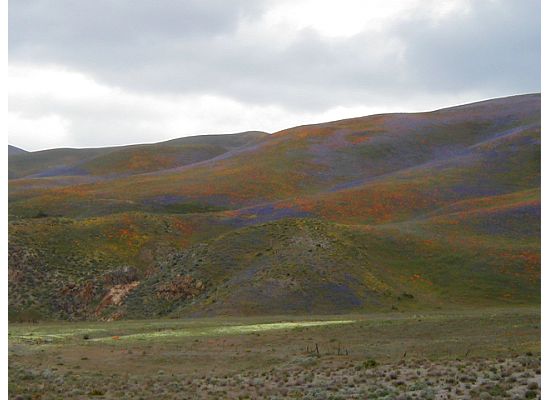
Several years back I went on a weekend vacation to Lancaster, California, to witness the Poppy Festival and California Poppies in the desert. On the way to Lancaster, I drove up the Grapevine and through Gorman, California. Some years, and I was lucky to have gone there during one of those years, for a brief few days the hills of Gorman are painted in color as if dropped right out of a painter's pigment jars. No artist could paint a scene as magical and fantastic as the one you see - live and in person - in front of you. I knew I was seeing one of the best things I had ever seen.
But wait a minute . . . . where's the bread crumb?
It's just this. Bad things happen. Bad things may happen to you. Nothing happens out of this "present moment." It happens, it is done and we may be many moments away from what happened. You can choose whether to ever think of it again. But you know what? Good things happen in this moment too. "Plastic bag moments." In one of my moments, I witnessed the beauty of Gorman, California and I can choose THAT to think of again. " . . . . it helps me remember. I need to remember."
Tuesday, March 3, 2015
It Takes 4 Weeks to Create a Habit (Republished)
I still have a cold. If you are in the Napa, California area, slather yourself in antibacterial gel. There is a cold here right now that lasts weeks. We say "cold" while secretly fearing pneumonia, laryngitis and bronchitis. I'm sure we're all gaining meaningful experience from this, but for right now? Can we just get a nap?
Today is Tuesday, though. Time for my regular Tuesday blog. I'm just not up to it today. So here is a reprint from one of my earlier blogs. I hope you enjoy it.
I read a lot of self help books. About a year ago, I learned in one of those self-help books that it takes four weeks for a human to create a habit. It almost seemed like a message from beyond because it was reinforced and confirmed by numerous sources all at once. But it frightened me a bit at the time because I was in the midst of what had been predetermined to be at least four weeks of jury duty.
Today is Tuesday, though. Time for my regular Tuesday blog. I'm just not up to it today. So here is a reprint from one of my earlier blogs. I hope you enjoy it.
*************************
What about those things you do involuntarily for four weeks? A habit? So I would live the first four weeks AFTER jury duty building a habit to go back to work?
Yep . . . kinda.
Now I have been on Twitter for at least four weeks. As I've said before, those of you who "get it" understand what fun I'm finding. Those of you who don't, I'm not trying to exclude you - think of it more like the difference between those who enjoy hockey and those who enjoy opera. Twitter just isn't your cup of tea.
But after making jokes about the shorthand that people use text messaging and worrying that I wouldn't be able to understand the world because I don't text message: I find my thought flow when I'm writing has begun stuttering and stammering. I have created a habit of writing in the 140 character Twitter allotment! Actually typing out the words "you" and "your" feels almost painful and I can't tell you how many times I've had to erase "@" and type in "at!"
Just the other day, my Dad said to me . . "as an English major . . " It's true, I graduated from college as an English major, but that was long ago and far away and doesn't seem to even be an accurate descriptor for me any longer. After creating my new 140 character habit, a monkey at a typewriter probably feels less apoplexy getting his grammar right than I do.
Four weeks and I have definitely created a 140 character habit . . . .
So why am I still reading self-help books to overcome the same old problems after years of working at it?
Recently I had an epiphany about that. Let me explain.
It came to me when I was up @ Amazon researching self-help books. See that's what I do. When I begin to struggle with sadness, anger or negative emotions, I either begin reading or listening to what I already have or go searching for more of the same. At that point, I guess I figured I needed new inspiration and anger must have been what I was struggling with; so I searched through online page after page of books about coping with, dealing with and overcoming your anger. Suddenly, like a cold slap across the face, all that I'd read kicked in and I understood my mistake.
It's a question of focus and attention.
One of my favorite things lately to allude to is the idea that Mother Theresa wouldn't attend anti-war rallies. Rather, her position was that if you held a pro-peace rally, then you could count on her attendance. See the difference? It can be subtle and meaningless to those who would relegate it to simply semantics. An anti-war rally is giving all the attention to what you DON'T WANT, but a pro-peace rally is properly addressing what you DO WANT.
So all those anger books? Well, of course, they simply reaffirmed and underscored that I was exactly what I didn't want to be: an unhappy, angry person. You can't exactly build the habit that you want when you're focusing on the wrong activity. Really, I was simply continuing a habit I already had - the habit of wanting to change what I was feeling.
When I created that 140 character habit, I didn't read about how to Twitter. I just tweeted and twittered & ; blipped & ; followed my way 2 finding nu ways of talking so u could get big pic in short sentence.
Habits r created by doing not planning to do.
:-)
Subscribe to:
Posts (Atom)